 Coinmarketcap
CoinMarketCap rankings help narrow a shortlist through supply and liquidity checks
CoinMarketCap rankings order cryptoassets primarily by circulating market capitalization, with eligibility rules affecting their placement. For a shortlist, use that position to identify relative size, then examine supply verification and available market liquidity. A large capitalization does not establish how easily a particular order would trade. Keep candidates provisional while comparing the same valuation basis, relevant trading pairs, and measurement dates. These distinctions help separate an asset worth investigating from a market suitable for a transaction.
Market Size or Tradable Markets
Your intended comparison determines which ranking matters: asset rankings compare capitalization, while market-pair rankings assess individual trading markets using different inputs. A market pair represents trading between two assets on a particular venue. Its conditions matter when the shortlist concerns potential execution. Exchange rankings describe a broader venue and cannot substitute for inspecting the relevant pair. Keep these levels separate so a favorable position in one list does not become an assumed advantage in another.
Supply Evidence Before Selection
Supply verification matters before a rank becomes a selection criterion because capitalization inherits the assumptions in its circulating-supply figure. Circulating supply estimates assets in public circulation. Total supply includes existing units outside that public float and excludes verified burns. CoinMarketCap defines maximum supply as the estimated lifetime maximum, also net of verified burns. These quantities answer different questions. A large difference between them warrants attention to distribution and release conditions, rather than an automatic conclusion about future selling. An allocation becoming available does not establish when its holders will sell.
CoinMarketCap evaluates supply information before publishing a verified circulating-supply figure. Its assessment also considers whether trading activity and liquidity support the proposed capitalization. Consequently, a project-provided number and a verified figure carry different evidential weight. An unresolved supply discrepancy belongs alongside the candidate's rank in research notes; replacing it with an assumed value creates false precision.
Parameters Behind the Shortlist
A consistent comparison needs defined metrics, because changing the supply basis changes the valuation even when the reference price stays unchanged. The relationships below describe the inputs behind a shortlist. They do not assign permanent values to any asset.
| Parameter | Definition or Interpretation | Required Inputs |
|---|---|---|
| Circulating market capitalization | Reference price × circulating supply | Matching asset, price currency, and circulating-supply figure |
| Fully diluted valuation | Reference price × maximum supply | An established maximum-supply figure and matching reference price |
| Market-pair Liquidity Score | Higher scores indicate lower modeled slippage | Order-book data for the specific trading pair |
| Market-pair Confidence Indicator | High, Moderate, or Low confidence in reported volume | Reported volume and the model's supporting market data |
Circulating market capitalization equals the reference price multiplied by circulating supply. Fully diluted valuation applies the maximum-supply basis at that price. It does not predict the price when additional supply circulates. Keep the two measures in separate columns when comparing candidates, and preserve missing inputs as missing.
Can the Available Market Support Your Order?
The relevant market must have sufficient opposing orders near the quoted price for the quantity you intend to trade. Market capitalization alone cannot answer that question. Order-book depth describes available quantities at different prices, while the spread separates the best available buying and selling quotes.
Order Size and Available Depth
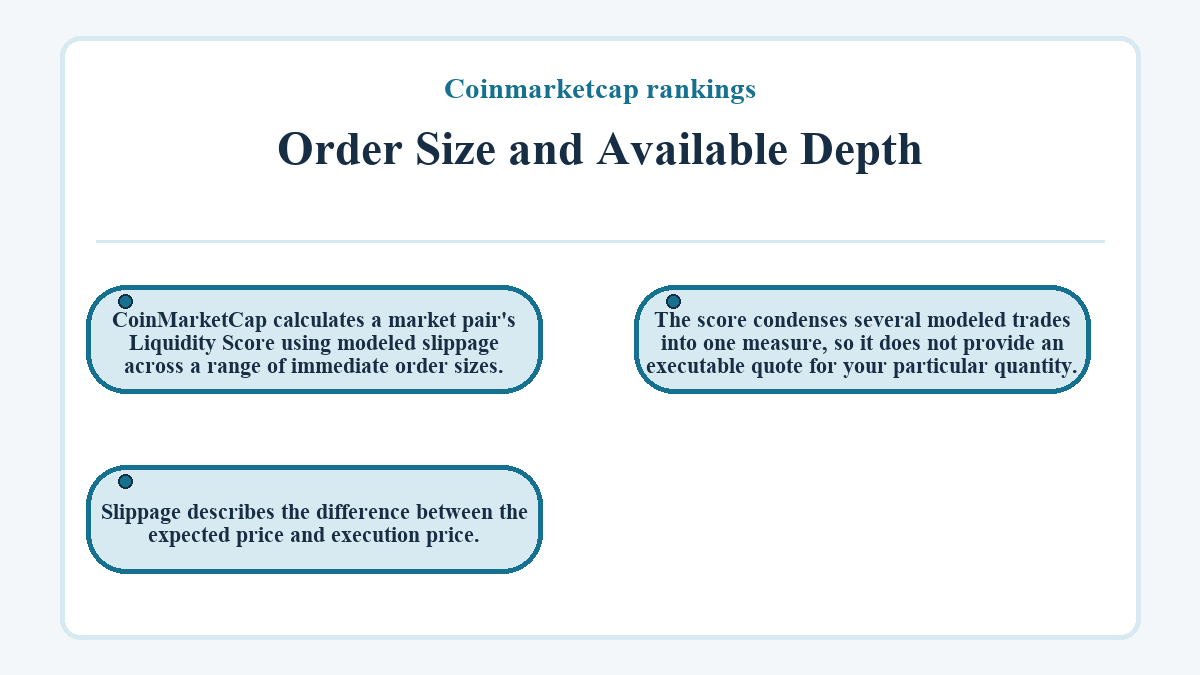
CoinMarketCap calculates a market pair's Liquidity Score using modeled slippage across a range of immediate order sizes. Slippage describes the difference between the expected price and execution price. The score condenses several modeled trades into one measure, so it does not provide an executable quote for your particular quantity.
Smaller Quantities
A smaller order may fit within the quantities available near the best quote. That makes the closest price levels especially relevant. Even then, displayed orders can change before execution.
Larger Quantities
A larger order can consume several price levels when the nearest orders cannot absorb its quantity. Its average execution price can therefore differ more from the initial quote. Increasing the intended quantity changes the liquidity requirement without changing the asset's rank. A shortlist based on a smaller quantity may consequently need revision, even if market capitalization remains unchanged and the same trading pair remains available.
Research and Execution Records
A shortlist remains an editable research choice. Executed trades create a separate record with actual quantities, prices, and fees. Any later portfolio entry should reflect that execution record, rather than the aggregate price visible during shortlisting. Changing the research notes cannot change an execution. You can complete the ranking review without making a purchase.
Reported Volume and Confidence
Reported volume needs a credibility check before it supports a shortlist, especially when trading activity appears inconsistent with available depth. The Confidence Indicator compares reported volumes with model estimates informed by liquidity, trading activity, and transaction data. It concerns confidence in the volume figure. A High label does not establish asset quality or venue solvency, and a Low label does not by itself prove misconduct. Keep the assessment attached to the market pair it describes.
Rank Changes Across Comparable Dates
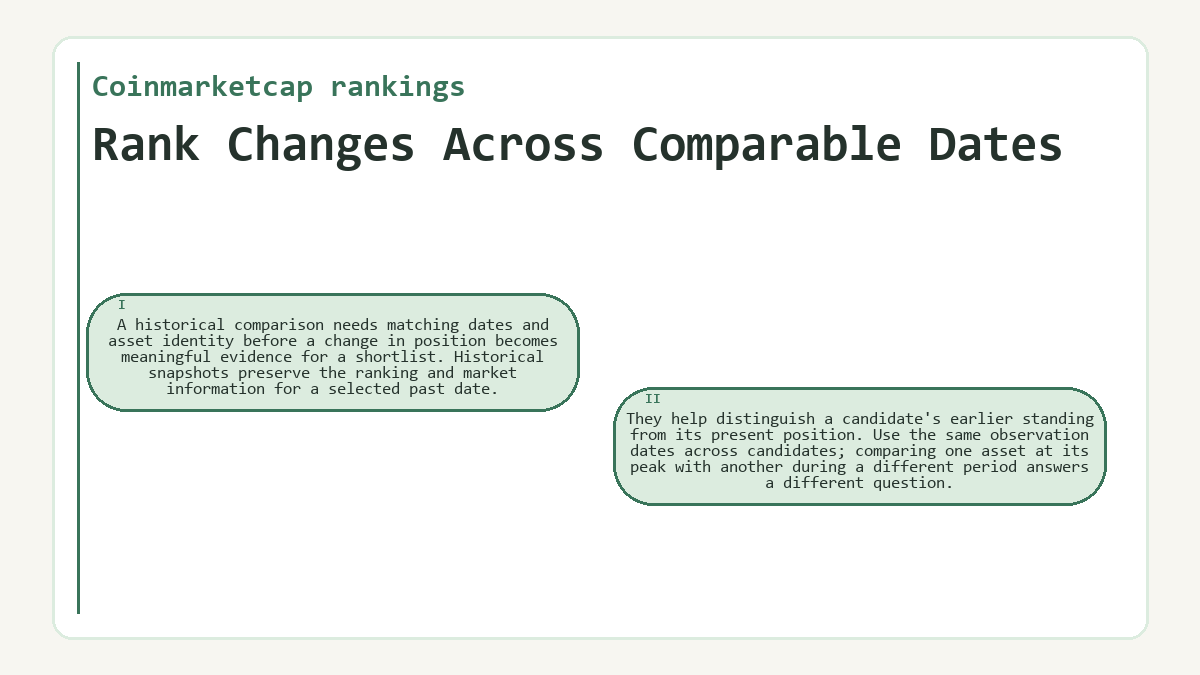
A historical comparison needs matching dates and asset identity before a change in position becomes meaningful evidence for a shortlist. Historical snapshots preserve the ranking and market information for a selected past date. They help distinguish a candidate's earlier standing from its present position. Use the same observation dates across candidates; comparing one asset at its peak with another during a different period answers a different question.
Rank is an ordinal measure: it shows position, not the distance between neighboring capitalizations. A move of several places can reflect a small valuation difference when nearby assets cluster closely together. Historical notes therefore need the associated capitalization and supply context. A chart of price alone cannot explain a ranking change involving revised supply, changed eligibility, or movements in other assets.
A Shortlist With Explicit Conditions
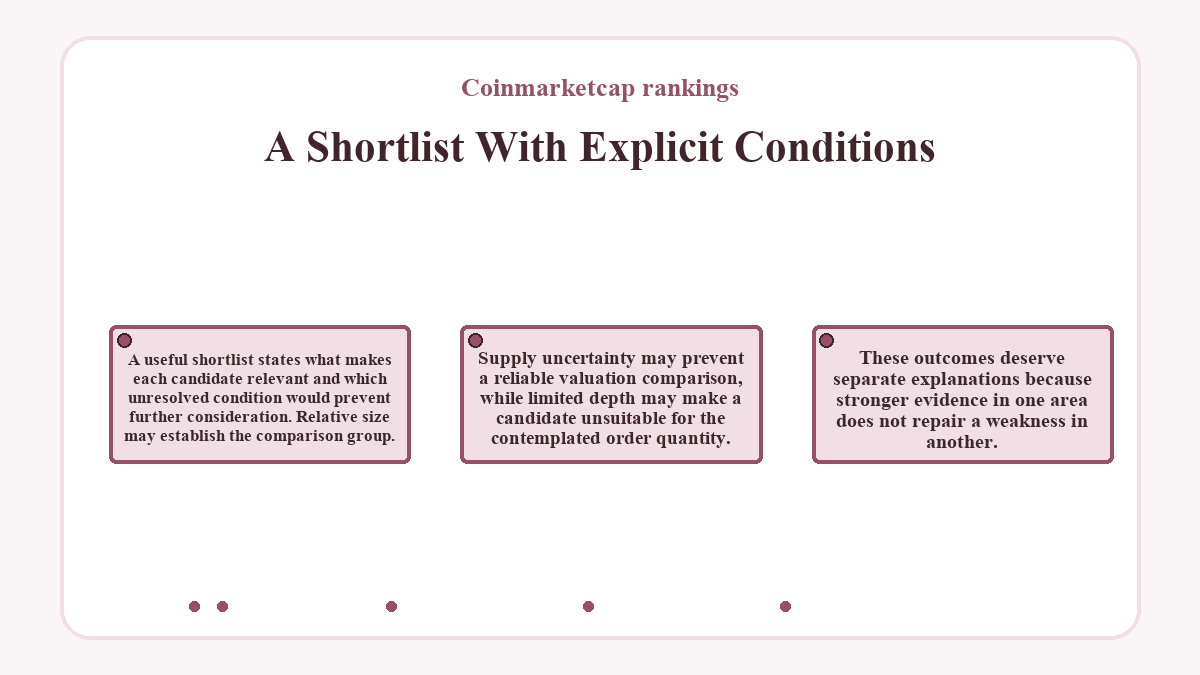
A useful shortlist states what makes each candidate relevant and which unresolved condition would prevent further consideration. Relative size may establish the comparison group. Supply uncertainty may prevent a reliable valuation comparison, while limited depth may make a candidate unsuitable for the contemplated order quantity. These outcomes deserve separate explanations because stronger evidence in one area does not repair a weakness in another.
Keep a watchlist distinct from a portfolio record of completed activity. A candidate can remain under observation without any transaction. The finished ranking review should leave each inclusion understandable, with unresolved inputs visible and no implied purchase commitment. For valuation comparisons, the essential relationship remains price × circulating supply.
Still wondering about Coinmarketcap rankings?
Does a Low Unit Price Make a lower-ranked Cryptocurrency Cheaper?
A low unit price does not establish a lower valuation because the circulating quantity also matters. Assets divide their supply into different numbers of units. Comparing capitalization avoids treating the price of one unit as the price of the whole asset supply, although capitalization alone still does not establish investment value.
Can an Asset Rise in Rank While Its Price Falls?
An asset can rise in rank while its price falls if other eligible assets lose more capitalization. Changes in circulating supply can also affect the comparison. A better position therefore does not necessarily indicate a positive price return over the same period.
What Does a Missing Market Capitalization Mean for Rank Eligibility?
Verified market capitalization is required for ranked placement. Top 200 eligibility also requires supply verification, listing criteria, market depth, a minimum profile score, and price consistency; verified capitalization alone does not establish Top 200 eligibility. CoinMarketCap places unranked assets in a separate category ordered by reported 24-hour trading volume. A missing value represents a data or verification limitation, rather than a capitalization of zero.
Are Wrapped and Staked Assets Always Ranked Alongside Their Underlying Assets?
CoinMarketCap uses a separate ranking tier for rehypothecated assets to address double counting of capitalization. Wrapped or staked representations can raise this issue because their value relates to underlying assets. Their placement therefore requires attention to the ranking treatment, rather than an assumption that every displayed capitalization belongs in one uninterrupted order.
How Should I Interpret a Liquidity Score Twice as High as Another?
A Liquidity Score twice as high does not mean twice as much liquidity. The score summarizes modeled slippage across different order sizes rather than measuring an executable quantity. Higher scores support a relative comparison, but the numerical ratio does not translate directly into a proportional increase in executable quantity.
Which Assets Belong in a Historical Shortlist Comparison?
A historical comparison should include the assets meeting the selection rule at the historical date, including those absent from today's shortlist. Selecting only current survivors changes the question and can obscure earlier failures or departures. The candidate group and observation date need to match the historical comparison you intend to make.
Will Converting Every Capitalization Into Another Currency Change the Order?
Applying the same positive currency-conversion factor to every capitalization preserves their mathematical order. Comparisons can become inconsistent when values use different conversion times or measurement bases. Use one currency and comparable timestamps when assembling a shortlist, especially when combining exported figures with separately recorded observations.